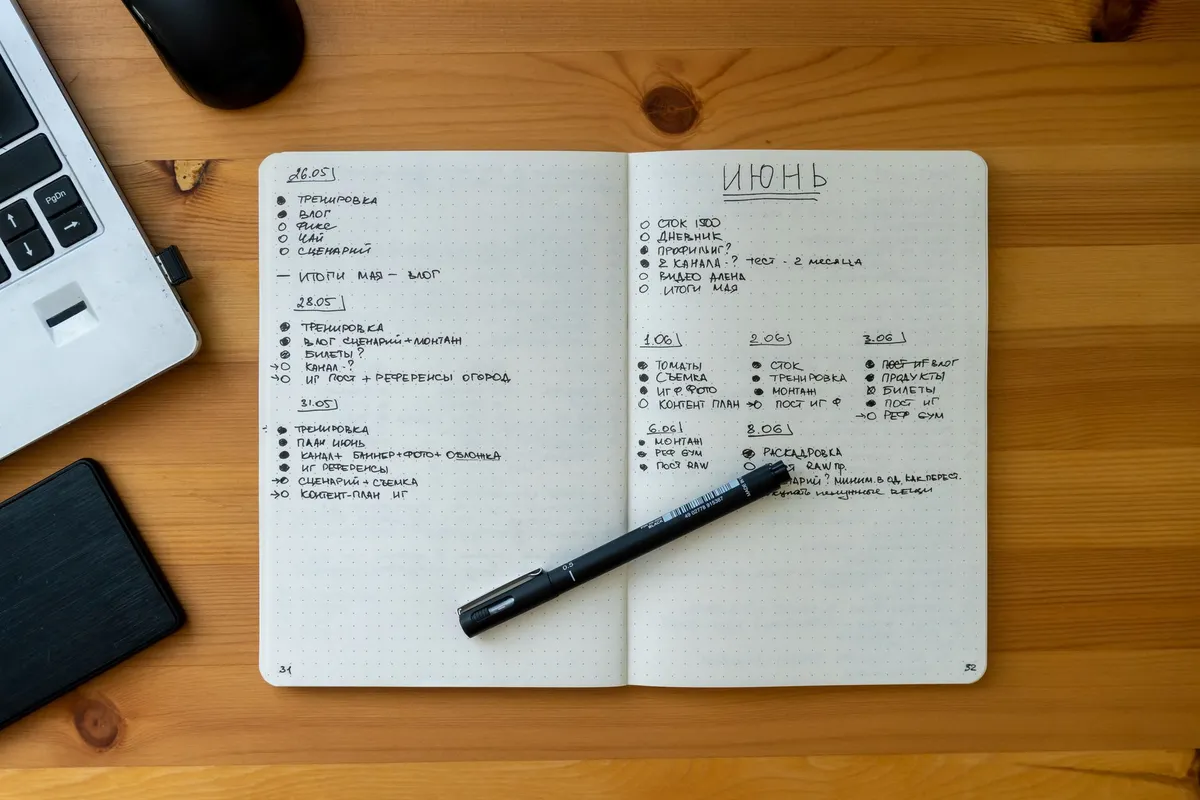
I own four notebooks and a task app with color-coded tags, and last Tuesday I spent thirty-five minutes moving “sort out insurance renewal” from one notebook to another. Then I made a coffee and felt, briefly, like a competent adult.
I did not sort out the insurance renewal.
I counted later, because I am the kind of person who counts these things instead of doing them: eleven. Eleven versions of essentially the same list in one week. Same four items, migrating from page to page like geese with nowhere better to be. The handwriting got neater each time. The tasks got no closer to done.
There is a very specific pleasure in a fresh page. You know the one. The pen that actually works, the first line sitting straight, the feeling that this version of the list is the real one and the last four were just warm-ups. For about ninety seconds the day looks manageable. You have taken the fog in your head and given it edges. It feels like progress in the body, that small warm flicker of having handled something.
And then it is 6 p.m. and the same four items are still breathing.
I used to think this was a planning problem. Wrong system, wrong app, wrong notebook size. I have tried the tiny pocket one and the big satisfying one and the app with the swipe gestures. What actually broke the loop was noticing something almost embarrassingly small about the words themselves.
Every single thing I kept rewriting was a noun
“Insurance renewal.” “Dentist.” “Tax stuff.” “Mum’s birthday.” “Website.”
Those are not tasks. Those are topics. They are the names of entire rooms I do not want to walk into, written on a line as if they were chores. No wonder my brain slid off them. You cannot do a topic. You can only worry about it, and then rewrite it somewhere nicer.
Compare: “open the renewal email and write down the policy number.” That is a thing a body can perform. It has a beginning, a verb, and a clear moment where it stops. My hands know what to do with it. My hands had absolutely no idea what to do with “insurance renewal,” so they picked up a pen instead, because a pen is the one tool that lets you look busy while deciding nothing.
When I switched to verbs, half my list evaporated in the first ten minutes. Not because I became disciplined. Because the actual actions turned out to be tiny and slightly stupid. “Dentist” had been sitting on my lists for five weeks. “Call the dentist and ask for any Thursday” took ninety seconds, including the hold music. Five weeks of carrying it, ninety seconds of doing it. That is the ratio I keep running into, and it is the same ratio I found the last time I spent four days avoiding an email that took four minutes.
So here is what I do now, and it is less a system than a rule about grammar.
One list. Written once. Maximum three lines. Every line starts with a verb my body recognizes: call, open, print, ask, send, find. If I cannot think of the verb, that is the signal the task is not ready yet and I am not allowed to write it on the good list. Everything else, all the vague swirling nouns, goes in one ugly dump file that I have banned myself from prettifying. No headings in there. No color. No order. It is a drawer, not a display case.
The three-line cap is the part people argue with me about. It felt insultingly small at first. But a three-line list cannot be rewritten in a pleasing way, which was the whole point. There is no craft in it. You just do the three things, and if you finish early you go fishing in the ugly file for a fourth.
The rewriting is information, not a character flaw
Here is the bit I want to be honest about, because I spent a long time treating this as evidence that I was lazy underneath, which is a very comfortable thing to believe and also completely useless.
The rewriting spikes at predictable times. When a task is vague, yes. But also when it is slightly humiliating. The email where I have to admit I forgot. The call where someone will hear that I let it lapse. The message to a friend I have not replied to in so long that the reply now needs a preamble, which is a whole separate mess I have written about elsewhere.
Those ones never get done by a better list. They get done by naming the wince. When I catch myself reaching for a clean page, I now ask what exactly I am dreading, and the answer is almost never “the task.” It is usually “looking like someone who let this slide.” Which, fine. I did let it slide. The list was never going to fix that, it was just going to keep me warm while I didn’t.
That is also why I stopped waiting for the version of me who would feel ready and organized enough to start, a habit I am apparently very committed to.
So: next time your hand goes for the fresh page, write the first physical action instead. One line. Starts with a verb. Then do it before the pen is back in the drawer.
A list you rewrite is a list you are hiding in. A list you can’t rewrite is one you have to finish.
Frequently asked questions
Is rewriting my to-do list actually procrastination?
Usually yes, but a comfortable kind. It gives you the feeling of handling something without requiring you to do any of it, which is why it is so hard to notice while it's happening.
How many items should be on a daily list?
Three is a good cap, mostly because three lines are too few to rewrite attractively. If you finish them, you can always pull another one from your dump file.
What if a task genuinely can't be reduced to one verb?
Then it isn't a task yet, it's a project, and it belongs in your messy catch-all rather than your daily list. Ask what the very first physical action is and write only that.
Do I need a different app for this?
No. The problem is the wording, not the tool, and a new app mostly buys you one more fun afternoon of setting it up.